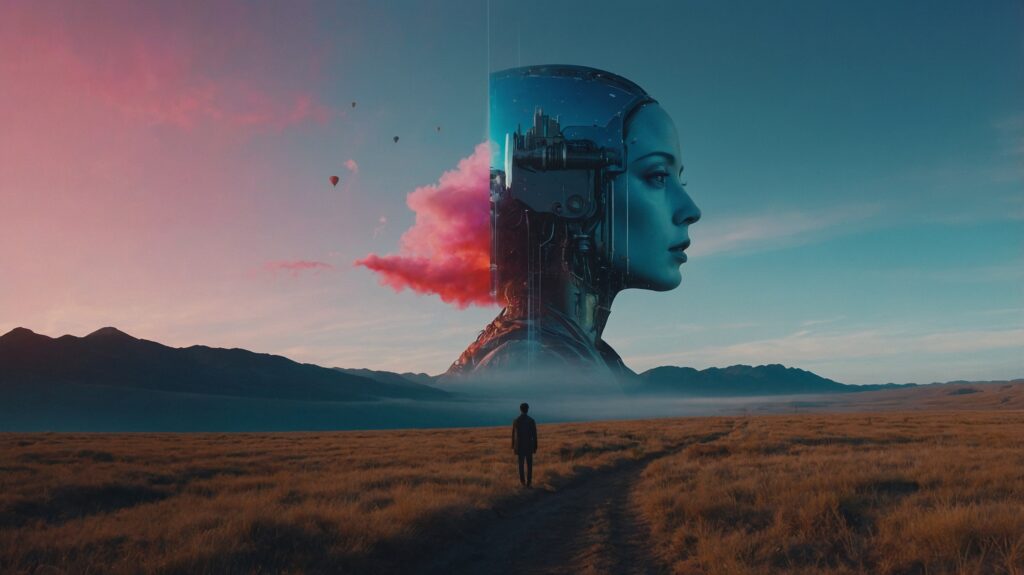
Artificial intelligence can now create art, write poetry, generate film scripts, and even simulate dreams. With just a prompt, machines can spin up surreal imagery, uncanny stories, or fantastical worlds in seconds. But as we marvel at these digital wonders, a deeper question quietly lingers:
Can AI truly understand human imagination—or is it just mirroring what it’s been taught?
At first glance, AI seems almost magical. It generates landscapes no one’s seen before, stories that evoke emotion, and music that moves us. But beneath the creativity lies a pattern—a reflection of everything it’s absorbed from human culture. And that’s the key: AI doesn’t imagine. It remembers.
The Mechanics of Machine Creativity:
AI “creativity” is powered by vast datasets and statistical associations. It doesn’t daydream or wonder. Instead, it analyzes patterns from billions of human-made examples and stitches them together in new ways.
When you ask an image generator to visualize “a dragon playing jazz on Mars,” it can produce a compelling picture—not because it understands dragons, jazz, or Mars, but because it has been trained on enough fragments to recombine them into something convincing.
This is impressive mimicry. But is it imagination?
What Is Human Imagination, Really?
Imagination isn’t just the ability to visualize new things—it’s rooted in experience, memory, emotion, and meaning. It draws on childhood dreams, cultural myths, personal fears, philosophical ideas, and unconscious desires. It allows us to envision alternate realities, empathize with others, and speculate on the impossible.
Most importantly, imagination is deeply tied to subjectivity. We imagine not just to create, but to understand. To hope. To escape. To feel.
AI doesn’t have an inner world. It doesn’t want or feel. It doesn’t look at a surreal image and reflect on its symbolism. It doesn’t wonder what could be. So while it can simulate imagination’s output, it doesn’t share its origin.
Simulating the Dream, Missing the Dreamer
One of the most powerful examples of this gap is in storytelling. AI can generate a compelling plot twist or an evocative metaphor. But it lacks the personal context that gives those creations depth. It doesn’t know what heartbreak feels like. It hasn’t stared at the stars and wondered why we’re here. It hasn’t lived.
It’s like reading a novel written by a ghostwriter with no life experience—fluent, polished, even moving, but somehow hollow at its core.
Co-Dreaming: A New Kind of Collaboration:
Still, that doesn’t mean AI is useless in the realm of imagination. In fact, it may be one of the most powerful collaborators we’ve ever known. Artists, writers, game designers, and musicians are already using AI to spark new ideas, test boundaries, and explore creative paths they might not have considered alone.
Rather than replacing imagination, AI may become a kind of digital dream partner—offering fragments, textures, and surprises that enrich the human creative process.
Think of it like jazz improvisation: the machine provides a riff, but it’s the human who feels the rhythm.
The Real Question: Do We Want Machines That Imagine? As AI models grow more sophisticated, some researchers are trying to build systems that mimic human-like imagination—models that don’t just generate based on prompts, but learn to ask their own questions.
This raises ethical and philosophical concerns. If we build machines that can simulate dreaming, reflection, or intuition, are we getting closer to real consciousness—or just building more convincing illusions?
And more importantly: Should we? Do we want machines that imagine, or are we better served by tools that inspire our imagination?
The Mystery Remains Ours:
AI can dazzle us with its creativity. It can surprise, amuse, and even move us. But for now, it does not dream. It does not wonder. It does not feel awe in the face of the unknown.
Imagination remains one of the last frontiers of human mystery—messy, emotional, and deeply personal. It’s not just about generating what’s new, but about exploring what’s meaningful.
So as we dream with machines, let’s remember: the soul of imagination still belongs to us.
Advertisement